Blog
PPL at Home and With Dumbbells: What Works and What Doesn't
Push Pull Legs does not only work in a fully equipped gym.
But PPL asks a home gym a particular question: do you have enough workable exercises and enough progression headroom for each specialised session?
A full-body day can already be complete with a squat variation, a press, a row, a hip extension and some accessory work. A PPL spreads the same muscle groups across three separate days — so on each individual day you need more variations for fewer body regions.
That does not make PPL at home wrong. It just makes the limits of your equipment more visible.
What works fine with dumbbells
The push day is the easiest to cover.
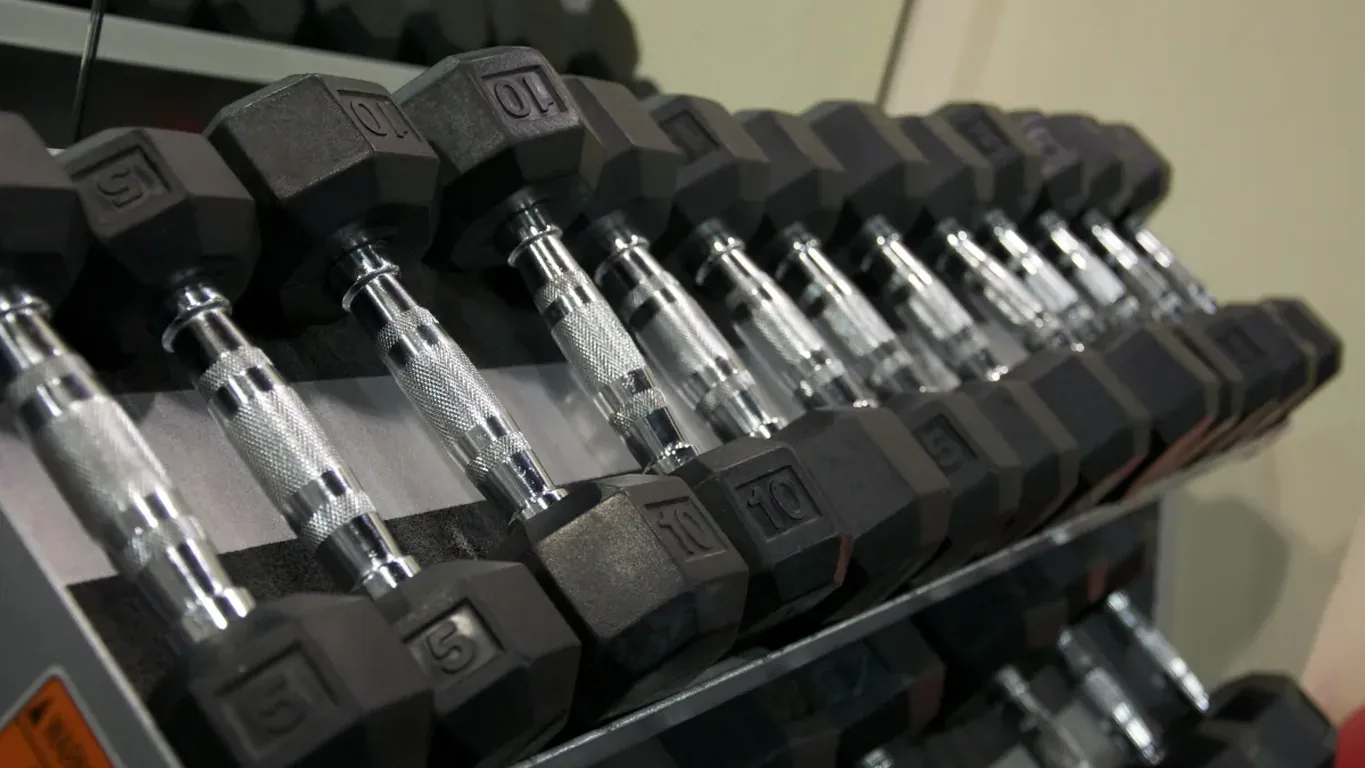
Dumbbell bench press, incline press, floor press, overhead press, lateral raises, flyes and triceps extensions cover almost every typical push slot. A bench widens the selection but is not a requirement — floor presses and push-up variations work without one.
Dumbbells are not an “inferior substitute” for barbells here. For muscle growth, the specific implement matters considerably less than sufficient load, range of motion and progressive overload. If your goal is specifically a stronger barbell bench press, though, barbell bench press remains the more appropriate exercise because of movement specificity.
The pull day can largely be built too. Single-arm rows, chest-supported rows on a bench, reverse flyes, hammer curls and standard curls all work without trouble.
The obvious missing piece is vertical pulling. More on that shortly.
The three places where it breaks
1. Leg day
In dumbbell leg training, the first problem is usually not the target muscle but the available total load and where it sits.
A goblet squat with 30 kg can be very demanding for a beginner. For a stronger lifter, that same 30 kg dumbbell eventually becomes too light, even though the legs could handle considerably more.
The best answer to that is often single-leg work:
- Bulgarian split squats
- lunges
- step-ups
- single-leg RDLs
- single-leg hip thrust variations
One leg is moving a larger share of the available load. That keeps the same dumbbell challenging for longer.
When even that weight is exhausted, other progression levers remain: more reps, a larger range of motion, controlled pauses, slower eccentrics or additional sets.
The order of those ideas matters: added difficulty should stay measurable. Tempo tricks are useful, but an adjustable pair of dumbbells with genuine load headroom remains easier to progress long-term.
2. Vertical pulling
With two dumbbells there is no genuine 1:1 substitute for pull-ups or a lat pulldown.
That does not mean your lats are untrainable without a pull-up bar. Row variations and dumbbell pullovers can load them. But the clear vertical pulling pattern that a classic PPL normally contains is missing.
A stable pull-up bar solves that problem very efficiently. If unassisted pull-ups are not there yet, you can work with band assistance, eccentric reps or easier variations.
Which purchase delivers the most per euro, and in what order, is covered in strength training at home without equipment.
Without a bar a pull day is still possible — it just leans more heavily on rowing.
3. The weight jump
The third bottleneck is not maximum load but sometimes the jump between two loads.
With a barbell you can increase very finely using small plates. With fixed dumbbells you might jump straight from 15 to 17.5 kg per hand. For lateral raises or overhead press, that can be a large relative step.
Which is why double progression suits dumbbells very well:
Stay at the same weight within a rep range, add reps first, and only raise the weight once you hit the top of the range cleanly across all prescribed sets.
For example:
3×8-12 overhead press
You start with 15 kg per hand at 10 / 9 / 8 reps. Across several sessions you work towards 12 / 12 / 12. Only then do you move to the next dumbbell and start closer to the bottom of the range again.
Adjustable dumbbells with small increments make exactly this progression considerably more pleasant.
The substitution catalogue
The slots stay the same as in the normal PPL blueprint; only the specific exercise changes.
| Slot | Gym | Dumbbells at home |
|---|---|---|
| Horizontal pressing | Barbell bench press | DB bench press, incline, floor press |
| Vertical pressing | Barbell overhead press | DB overhead press |
| Chest isolation | Cable fly | DB fly flat/incline, feet-elevated push-up |
| Triceps | Pushdown | DB overhead extension, close-grip push-up |
| Vertical pulling | Lat pulldown | Pull-ups/chin-ups on a bar |
| Horizontal pulling | Cable row | Single-arm DB row |
| Rear delt | Face pull | Reverse fly, band pull-apart |
| Squat pattern | Squat | Bulgarian split squats, goblet squats |
| Hip pattern | Romanian deadlift | DB RDL, single-leg RDL, hip thrust |
| Quads | Leg press | Lunges, step-ups |
| Knee flexion (hamstrings) | Leg curl machine | Nordic curls, slider curls |
| Calves | Calf raise machine | Single-leg calf raise on a step |
The right-hand column is not a collection of last resorts. Many of these exercises can build the target muscles excellently.
The differences lie mainly in load ceiling, stability and ease of progression — not in whether an exercise happens in a gym or a living room.
The honest alternative
If all you have at home is two dumbbells and little other equipment, PPL is often more complicated than necessary.
Not because the split is bad with dumbbells, but because it demands many variations for individual muscle groups. A full-body or upper/lower plan uses the same few strong exercises repeatedly and spreads them across less specialised days.
That is the same arithmetic as in PPL vs. upper/lower, plus an equipment question: the smaller your exercise selection, the more attractive a split becomes that does not need five different push exercises in a single session.
The hitPR catalogue has finished plans for this, but no dumbbell PPL:
- Dumbbell Foundation — full body, 3 days, dumbbells and a stable bench. Either compact with 5 exercises or standard with 8.
- Upper/lower, “dumbbells only” variant — 4 days, dumbbells plus bench and pull-up bar. This particular catalogue plan assumes heavy adjustable dumbbells, so the prescribed progressions keep working long-term.
- Bodyweight muscle building — 2, 3 or 4 days, pull-up bar and band only. Progression through reps and harder exercise variations rather than primarily through added weight.
These are not inherently “better” splits. They just often use a limited home gym more efficiently.
If you have a barbell and a rack
With a barbell, rack, bench and pull-up bar, the biggest home-gym problems disappear.
You can squat and press heavy, have practically unlimited progression headroom for RDLs and deadlifts, and cover vertical pulling with pull-ups. Cables and machines then become mainly questions of convenience and variety.
The Reddit PPL has a “6 days (barbell)” variant for exactly this case, which works without a large machine setup and uses free weights plus bodyweight.
A full PPL at home is entirely possible that way.
Machines only
The reverse case works too: a gym with a good machine setup and little interest in free weights.
For muscle growth that is not a fundamental problem. Current overview work finds no consistent hypertrophy advantage from the implement alone. Chest press, shoulder press, lat pulldown, row machine, leg press, leg curl, leg extension and calf machines can cover the major PPL slots completely.
What machines do not provide automatically is exercise specificity for free-weight compound lifts. If your goal is a stronger barbell bench press, a better squat or a heavier deadlift, you have to train those movements too.
The Machine Only plan in the catalogue takes the machine route as full body on 2 or 3 days, or as upper/lower on 4 days. That there is no PPL there is a product decision for these variants — not an indication that a machine PPL would not work.
Conclusion
PPL at home is possible. The question is not “dumbbells or gym?” but whether your equipment offers enough progression headroom for the exercises you have chosen.
The key points:
- Push can be trained very completely with dumbbells.
- Pull works well too; a pull-up bar adds the missing vertical pulling pattern.
- On leg day the available load is usually the first bottleneck. Single-leg exercises extend the progression path considerably.
- Double progression helps when weight jumps are coarse.
- Machines can cover a complete PPL; free weights are not strictly required for hypertrophy.
- With little equipment, full body or upper/lower is often simpler, because they demand fewer exercise variations per specialised session.
The split is a tool. When your setup grows, you can always go back: the Push Pull Legs guide describes what PPL looks like fully built out.
Sources
- American College of Sports Medicine. (2026). Resistance Training Prescription for Muscle Function, Hypertrophy, and Physical Performance in Healthy Adults: An Overview of Reviews.
- Pallares JG et al. (2021). Effects of range of motion on resistance training adaptations: A systematic review and meta-analysis. Scandinavian Journal of Medicine & Science in Sports, 31(10):1866-1881.
- Kassiano W et al. (2023). Which ROMs Lead to Rome? A Systematic Review of the Effects of Range of Motion on Muscle Hypertrophy. Journal of Strength and Conditioning Research, 37(5):1135-1144.
- Maeo S et al. (2021). Greater Hamstrings Muscle Hypertrophy but Similar Damage Protection after Training at Long versus Short Muscle Lengths. Medicine & Science in Sports & Exercise, 53(4):825-837.
Frequently Asked Questions
Related Articles
Coming soon
Coming soon for Android and iOS. Be there for the launch.