Blog
Strength Training for Women: Myths, Facts, Training Plan
Women need no fundamentally different strength training.
That is the central point of this article — and it is more nuanced than “women and men are exactly the same”.
The basic training principles apply to both:
- exercises with enough resistance,
- progressive overload,
- enough productive volume,
- sensible proximity to failure,
- and enough recovery.
Differences between the sexes do exist. Most of them, though, are smaller and more context-dependent for actual training planning than typical “women’s fitness” programs suggest.
Myth 1: “Strength training automatically makes women too muscular”
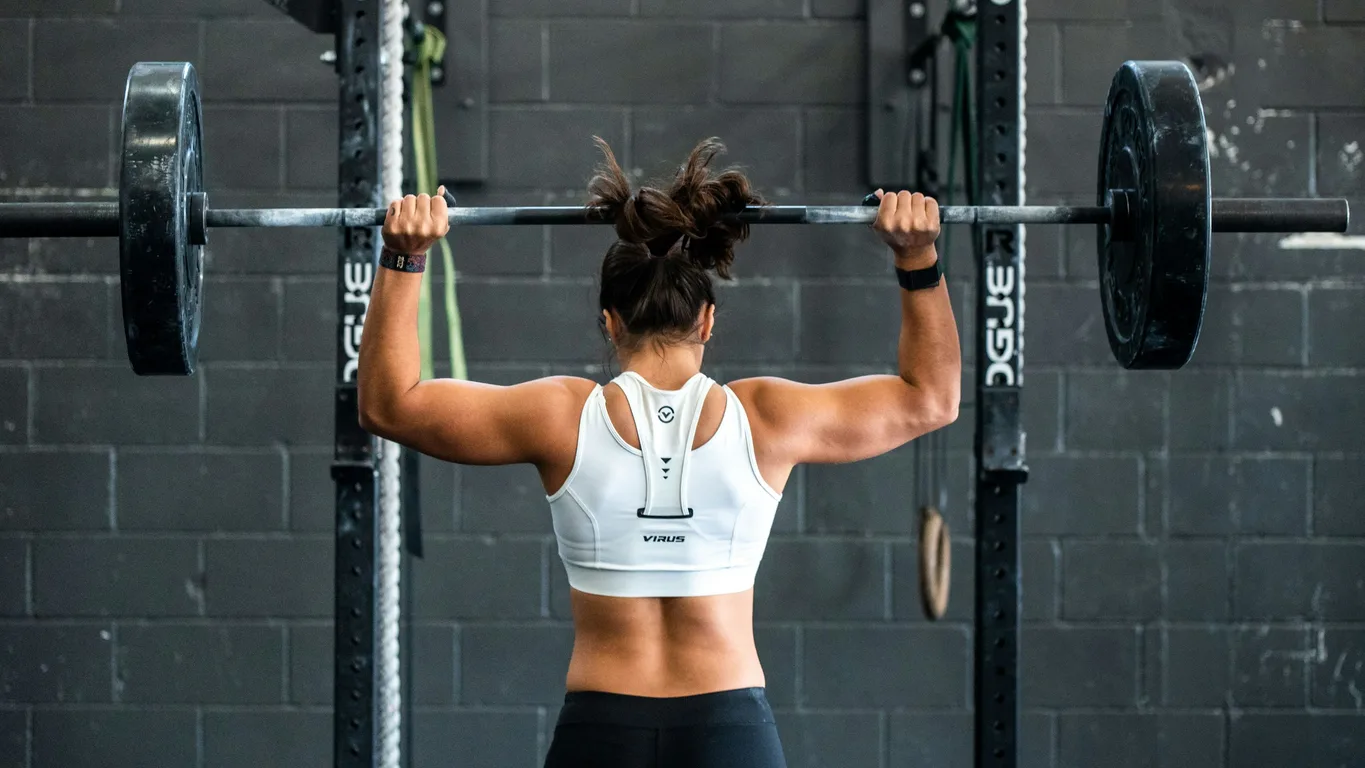
Strength training builds muscle. That holds for women too.
So it would be just as wrong to say women can barely build muscle as to claim that a few months of bench pressing and squatting automatically produce an extremely muscular body.
Systematic comparisons show that women can achieve similar relative hypertrophy gains to men on identical strength training. Men often gain more muscle mass in absolute terms, because of their higher starting muscle mass and other biological factors, but relative to the starting point the differences are considerably smaller.
In practice that means:
Yes, you can build visible muscle as a woman.
No, it does not happen uncontrollably overnight.
A very muscular body comes from years of targeted training, matching nutrition, high training volumes and individual predisposition.
If your goal is more like “athletic”, “stronger” or “a bit more defined”, you steer your training accordingly. Muscle growth is gradual, and it can be influenced through volume, exercise selection and nutrition.
So the better question is not:
Will I get too muscular?
But:
Which areas of my body do I want to develop, and how much training volume do I want to spend on that?
Myth 2: “Women should train with lighter weights”
Two things need separating here.
Women move lower absolute loads than men on average. Which is not a surprising statement — absolute strength depends on muscle mass, height, training status and the exercise, among other things.
It does not follow that women should train lighter relative to their own capacity.
A working set with 70 kg can be very hard for one person and easy for another. What counts is the load relative to your own strength.
So the same basic tools apply to women:
- heavy sets for strength,
- moderate and light loads for muscle growth,
- RPE or RIR to steer effort,
- clear progression rules,
- and rep ranges that suit the exercise in question.
The pink 2-kg dumbbell is not “more feminine”. It is simply a 2-kg weight — useful when 2 kg suits the exercise, and too light when 2 kg no longer delivers a sufficient training stimulus.
Women respond to strength training similarly well on average
A meta-analysis by Roberts, Nuckols and Krieger compared studies in which men and women completed the same strength training.
The result was far less dramatic than a lot of sex-specific training advice:
- hypertrophy: no relevant difference in relative adaptation,
- lower-body strength: no clear difference,
- relative upper-body strength: in that analysis, even larger relative gains in women.
Newer analyses likewise support the idea that women have similar hypertrophy potential in proportion to their starting muscle size.
Which is why a sensible training plan does not begin with the question:
Man or woman?
But with:
- training goal,
- training status,
- days available,
- equipment,
- preferences,
- injury history,
- and current tolerance.
Are there relevant differences all the same?
Yes — they are just rarely as simple as “women need more reps”.
Women sometimes manage more reps at the same relative load
Some studies show that women can complete more reps at the same percentage of 1RM on certain exercises and loads.
This does not show up equally on every exercise and in every population, but it is plausible enough to have a practical consequence:
Rigid percentage-to-rep tables are imprecise at the individual level.
If two people train at 75 % of their 1RM, they do not have to reach the same rep count — regardless of whether the difference comes from sex, training background or individual physiology.
RPE, RIR and actual set performance are often more useful for fine-tuning than the assumption that “75 % = exactly 10 reps”.
Women can fatigue more slowly in some protocols
Recent work shows that in certain multi-set protocols, women complete more reps or recover better between short rest periods.
That is interesting, but it is no licence for the rule:
Women always need shorter rests and more volume.
A recent scoping review found small to no consistent sex differences overall in neuromuscular fatigue in trained people. A bench press study published in 2026 did find considerably more reps completed by women, but no faster recovery of strength over the following 72 hours.
So the practical conclusion is sober:
Women can tolerate more work in individual situations — the optimal volume should still be steered individually through performance and recovery.
More volume just because you are a woman? No
Blanket volume ranges such as “women tolerate 20 % more” sound precise but are not well founded.
The right volume depends more heavily on other things:
- training experience,
- exercise selection,
- proximity to failure,
- rest periods,
- sleep,
- nutrition,
- stress,
- and individual response.
Two women can respond very differently to the same plan. The same goes for two men.
Which makes progression plus recovery a better steering mechanism than a sex-specific set formula.
Menstrual cycle: less certainty than social media suggests
The evidence here has grown considerably more sober in recent years.
One widespread concept is so-called cycle syncing:
- train harder in the follicular phase,
- reduce volume in the luteal phase,
- use particular phases for strength or hypertrophy work.
The theory sounds plausible, because oestrogen and progesterone fluctuate across the cycle.
But plausibility is not yet a solid training effect.
An umbrella review from 2023 concludes that the available studies on strength performance and long-term adaptations are highly heterogeneous and frequently have methodological problems. The authors consider it premature to derive general cycle-phase-based strength training plans from the current data.
Earlier meta-analyses likewise found at most small or inconsistent differences between cycle phases on objective strength measures.
What does that mean in practice?
Do not automatically train lighter just because a calendar app says “luteal phase”.
Watch your own recurring symptoms instead.
If on certain days you regularly experience
- severe cramps,
- sleep problems,
- unusual fatigue,
- headaches,
- or noticeably worse tolerance for load
then adjusting your training on those days can make sense.
But that is symptom-based autoregulation, not the assumption that every woman is automatically weaker on cycle day 24.
If you notice no relevant fluctuations in performance, on the other hand, there is currently no good reason to tie your whole training plan artificially to cycle phases.
Myth 3: “Cardio is for fat loss, strength training is for muscle”
This split is too simple as well.
Body fat changes above all through long-term energy balance. Training influences how much energy you use and which body mass you retain or build.
Strength training can reduce body fat while building or maintaining fat-free mass. Meta-analyses show measurable improvements in body composition from strength training alone as well.
Aerobic training has a different advantage: it often allows a relatively large amount of extra energy expenditure and improves endurance capacity.
Newer comparisons therefore show a plausible pattern:
- Aerobic work can reduce more absolute fat mass than strength training alone in longer interventions.
- Strength training is especially valuable for muscle mass and strength.
- A combination can serve both goals.
So the best answer is rarely “cardio or strength training”.
For many people it is:
Strength training as the base + everyday movement + cardio in an amount that suits the goal and your recovery.
How much steps and daily activity contribute to that is covered in the article on NEAT and fat loss.
Do women need different exercises?
No — not because of their sex.
Squats, rows, bench press, pull-up variations, deadlifts, hip thrusts, lunges, overhead press or curls do not work “for men” or “for women”.
You choose exercises by
- target muscle,
- movement goal,
- comfort,
- equipment,
- your own anatomy,
- and how much you enjoy them.
If you want to develop your glutes more, a higher share of hip thrusts, RDLs, split squats and other hip and leg work makes sense.
But that is goal-driven programming, not proof that women fundamentally need a glute plan.
A man with the same goal could set the same emphasis.
Which program fits?
The consistent answer: the same selection principle as for anyone else who trains.
To start with a barbell
The Basic Beginner Routine uses a few basic lifts, fixed rep targets without AMRAP, and a simple linear progression.
It suits you if you want to use a rack and a barbell and are looking for a clear way in.
For dumbbell training
Dumbbell Foundation uses dumbbells, a stable bench and double progression.
That is practical at home, or if you would rather start without a barbell.
If you deliberately want a glute focus
Glute Focus puts more training volume on the glutes and lower body.
The Glute Builder (Home Gym) pursues the same emphasis with home gym equipment.
The important difference from a generic “women’s plan”:
The emphasis comes from your goal, not from your sex.
If machines suit you better
Machine-Only uses guided exercises and lowers the technical demands on many movements.
That is neither “beginner training” nor “training for women”. Machines are simply a different tool for progressive loading.
If you want to start without a gym
Bodyweight Beginner works without classic gym equipment and pairs some exercises as supersets.
What stays important across all variants: the plan needs a progression you can follow. Which is exactly what the article on double progression is about.
Strength standards: sex matters more for comparison than for programming
When you are planning a working set, your own performance level matters more than a sex average.
With strength standards it looks different.
Absolute strength values differ between male and female populations. So if you compare your performance against reference groups, that context should be taken into account.
The strength standards calculator offers separate reference values for exactly that.
It is a good example of where sex can be practically relevant:
in interpreting comparison data — not as an automatic prescription for exercises and set schemes.
Nutrition stays just as individual
Women need no secret special rules for building muscle either.
Enough energy and protein support training and adaptation. How much of each makes sense depends on body weight, goal, overall diet and training volume.
Protein needs for muscle growth explains the usual ranges and how to apply them to your body weight.
If your primary goal is building muscle, the programming basics are also in the hypertrophy guide. For a general start, strength training for beginners is the better starting point.
Conclusion
Strength training for women needs no physics of its own.
The most important training principles are the same:
- load progressively,
- complete enough productive sets,
- choose suitable exercises,
- measure progress,
- and account for recovery.
At the same time, the research shows real differences that there is no need to talk away: women can manage more reps at some relative loads and fatigue more slowly in certain protocols. But no universal formula for more volume or shorter rests for women follows from that.
The menstrual cycle deserves individual attention too — above all when symptoms affect your training regularly. The current evidence does not support rigid cycle-phase-based training planning for all women, though.
A good training plan is therefore not written “for women”. It is written for your goal, your training status and how you actually respond to training.
Further reading:
- Strength training for beginners
- Hypertrophy training: guide for muscle growth
- Double progression explained
- Protein needs for muscle growth
- NEAT: why steps count for more than cardio
Sources
- Roberts BM, Nuckols G, Krieger JW. (2020). Sex Differences in Resistance Training: A Systematic Review and Meta-Analysis. Journal of Strength and Conditioning Research, 34(5):1448–1460.
- Colenso-Semple LM et al. (2023). Current evidence shows no influence of women’s menstrual cycle phase on acute strength performance or adaptations to resistance exercise training. Frontiers in Sports and Active Living, 5:1054542.
- McNulty KL et al. (2020). The Effects of Menstrual Cycle Phase on Exercise Performance in Eumenorrheic Women: A Systematic Review and Meta-Analysis. Sports Medicine, 50:1813–1827.
- Blagrove RC, Bruinvels G, Pedlar CR. (2020). Variations in strength-related measures during the menstrual cycle in eumenorrheic women: A systematic review and meta-analysis. Journal of Science and Medicine in Sport, 23(12):1220–1227.
- Refalo MC et al. (2025). Sex differences in absolute and relative changes in muscle size following resistance training in healthy adults: a systematic review with Bayesian meta-analysis. PeerJ, 13:e19042.
- Nuckols GL et al. (2026). The effects of biological sex on fatigue during and recovery from resistance exercise. PeerJ, 14:e20542.
- Wewege MA et al. (2022). The Effect of Resistance Training in Healthy Adults on Body Fat Percentage, Fat Mass and Visceral Fat: A Systematic Review and Meta-Analysis. Sports Medicine, 52(2):287–300.
- Lafontant K et al. (2025). Comparison of concurrent, resistance, or aerobic training on body fat loss: a systematic review and meta-analysis. Journal of the International Society of Sports Nutrition, 22(1):2507949.
Frequently Asked Questions
Related Articles
Coming soon
Coming soon for Android and iOS. Be there for the launch.