Blog
Strength Sports vs Bodybuilding vs Powerlifting
Contents
“I do strength training” can mean many things in everyday life.
For one person it means squats, bench press and deadlifts. For another it means push/pull/legs, machines and targeted muscle building. In competitive sport the differences are fairly clear. In a normal gym they blur quickly.
That is not a problem — as long as you know which goal is actually steering your training.
What “strength sports” actually means
In ordinary usage, strength sports is an umbrella term for sports and training forms in which external resistance and the development of strength or muscle mass play a central role.
That includes, among others:
- powerlifting
- olympic weightlifting
- strongman
- bodybuilding
- and in a broader sense, non-competitive strength training in a gym
In sports science and competition terms, these are of course not identical disciplines. The key difference lies in the competition criterion:
- In powerlifting, the load lifted counts.
- In weightlifting, two technically defined lifts count.
- In strongman, performance in changing events counts.
- In bodybuilding, the physique presented is judged.
So anyone training three times a week who wants to get stronger and build muscle does not have to subordinate themselves to one of these labels straight away.
The comparison is still worth making, though. Because each discipline shows quite well how strongly specificity shapes a training program.
The disciplines at a glance
Bodybuilding
Bodybuilding does not optimise the heaviest weight lifted but visible musculature: muscle mass, proportions, symmetry, and in competition also conditioning and presentation.
That changes the training logic.
In bodybuilding, an exercise is valuable above all when it loads the target muscle well and can be progressed sensibly over time. Whether it looks particularly “athletic” or is tested in competition is secondary.
Which is why exercise selection is usually broad:
- compound lifts
- machines
- cables
- isolation exercises
- different rep ranges
A push/pull/legs plan is a typical example of a bodybuilding-adjacent way to organise training, even when the lifter never wants to step on a stage.
Weekly volume can get relatively high with experience. But a fixed rule like “advanced lifters always need 12–20+ sets per muscle” cannot be derived from the evidence. The current ACSM overview from 2026 sees advantages for hypertrophy at higher volumes; roughly 10 or more sets per muscle group per week was frequently more favourable at group level than very low volumes. How much additional benefit accrues beyond that is individual.
More on this in the guide to sets per muscle group.
Powerlifting
Powerlifting is defined considerably more narrowly.
In competition there are three disciplines:
- Squat
- Bench press
- Deadlift
The best valid attempt in each produces the total.
In Germany the BVDK uses the IPF rulebook; the current version of the IPF rulebook has applied there since March 2026.
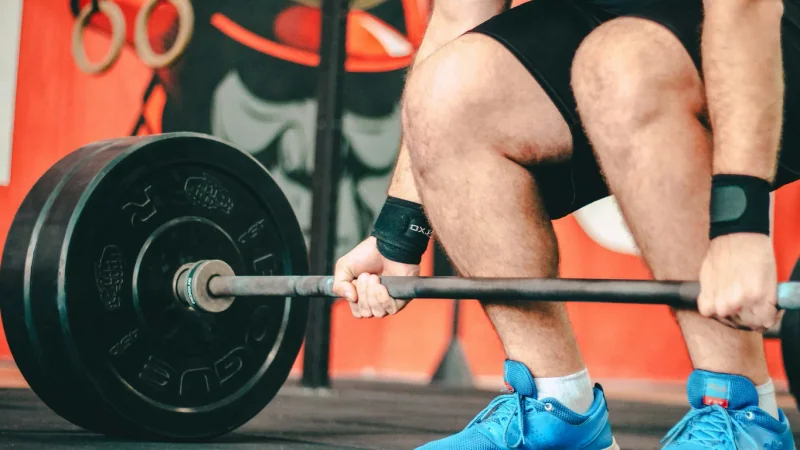
That competition structure makes the training specific. Anyone who wants to move as much as possible in powerlifting has to train exactly those three lifts, or very close variations, regularly.
Assistance exercises like rows, overhead press, leg press or leg curls are not worthless — they simply serve a different purpose. They build muscle, address weaknesses or provide volume without endlessly repeating the competition lifts themselves.
For maximal strength, the load level matters. Meta-analyses and the 2026 ACSM overview show consistently: heavier loads, particularly in the range of around ≥80% 1RM, produce greater 1RM strength gains than very light loads.
That is specificity in its purest form: anyone who wants to improve very heavy singles has to train regularly with high loads.
For a rough sense of where your performance currently sits: strength standards.
Olympic weightlifting
Olympic weightlifting consists of two competition disciplines:
- the snatch
- the clean & jerk
Both demand high strength, but equally speed, timing, mobility and technical precision.
That explains why the training looks different from a classic hypertrophy plan. Many sets stay at low rep counts, because technique and explosiveness can suffer quickly under mounting fatigue.
Alongside the competition lifts, variations like pulls, front squats, back squats and technical partial movements typically belong in the training.
For ordinary gym trainees, olympic weightlifting is not “too complicated”, but it is technically demanding. Anyone who really wants to learn the snatch and clean & jerk benefits greatly from qualified coaching — not because the lifts are mystical but because small technical errors change the movement considerably.
Strongman
Strongman is less standardised than powerlifting.
Depending on the competition, quite different events can appear:
- log press
- atlas stones
- farmer’s walk
- yoke carry
- deadlift for reps
- medleys
- pulling or carrying events
So a strongman does not only have to be maximally strong. Grip strength, strength endurance, moving under load and event-specific technique all play a large role too.
The training therefore combines heavy compound lifts with specific event work.
The injury data sits higher than in many other strength sports. A systematic review found roughly 4.5–6.1 injuries per 1000 training hours for strongman. Those figures come predominantly from retrospective observational data, though, and should not be read as an exact personal risk forecast.
Training differences: what the research says
The differences between bodybuilding and powerlifting can be summarised roughly like this:
| Parameter | Bodybuilding | Powerlifting |
|---|---|---|
| Rep range | broad; frequently moderate and higher reps | a heavy emphasis, supplemented by moderate reps |
| Intensity (%1RM) | often moderate, heavy or light depending on the exercise | regularly high loads, especially near competition |
| Sets/muscle/week | tends towards higher hypertrophy volume | volume organised more around the big 3 and variations |
| Training days/week | often 3–6, depending on the split | often 3–5, depending on the program |
| Rest periods | several minutes on compounds, shorter possible on isolation | often longer rests on heavy main sets |
| Exercise selection | broad, lots of targeted muscle work | focus on the big 3 + specific variations |
| Primary adaptation | muscle mass / stage physique | maximal strength in squat, bench, deadlift |
These are typical tendencies, not rules.
A powerlifter can do sets of twelve. A bodybuilder can bench press heavy. Both need progressive overload and both can benefit from sensible periodization.
The difference lies in which adaptation ultimately gets priority.
The truth about rep ranges
The old idea of three clearly separated ranges — low reps only for strength, 8–12 only for muscle growth, high reps only for endurance — is too simple.
For muscle growth, meta-analyses show a broad effective load spectrum. Lower and higher loads can produce similar hypertrophy when the sets are demanding enough and enough training work accumulates.
For 1RM strength it looks different: heavier loads clearly come out ahead.
That makes practical sense.
So a bodybuilder can build muscle at 6, 10 or 20 reps and choose the rep range by exercise and comfort. A powerlifter additionally needs regular heavy work, because a competition 1RM is a very specific performance.
The consequence is not “rep ranges do not matter”.
It is:
Rep ranges are tools for different kinds of training work — not biological pigeonholes.
Rest periods: bodybuilding got it wrong
The classic recommendation of “30–60 seconds rest for maximum pump and muscle growth” has aged badly as a general rule.
A well-known study in trained men found better strength and hypertrophy outcomes at three minutes of rest than at one minute. The probably most important practical reason: with more recovery you can do more high-quality work in the following sets.
But it does not follow that every curl rest has to last three to five minutes.
In practice:
- heavy squats, deadlifts and presses: often 2–5 minutes sensible
- smaller isolation exercises: frequently 1–3 minutes sufficient
- supersets: usable when the muscle groups overlap little
Your rest period should be long enough that the next set serves its purpose — not so short that the clock itself becomes the training goal.
Volume: the strongest hypertrophy driver
Training volume is one of the most important modifiable factors for muscle growth.
But the relationship is not a simple straight line along the lines of “more sets = always more muscle”.
The current ACSM position found better hypertrophy on average at higher volumes, particularly from around ten sets per muscle group per week. At the same time there are large individual differences, and beyond a point additional sets have diminishing benefit at rising fatigue.
In practice:
- Beginners can grow noticeably on relatively little volume.
- Advanced lifters often need more work, but not automatically 20+ sets for every muscle.
- Powerlifters need enough muscle-building work but additionally have to account for the fatigue from heavy specific work.
So the better approach is: start with a sensible volume, watch performance and recovery, and then adjust.
The volume guide goes into exactly that.
Injury risk: what the numbers say
Strength sports look more dangerous from the outside than the available injury data suggests.
A review across competitive weight-training sports found roughly the following ranges:
| Discipline | Injuries/1000 hours |
|---|---|
| Bodybuilding | 0.24–1.0 |
| Powerlifting | about 1.0–4.4 |
| Weightlifting | about 2.4–3.3 |
| Strongman | about 4.5–6.1 |
| Football (rough context figure) | frequently higher, depending on training/competition and definition |
But the table needs an important footnote:
These figures are not perfectly directly comparable. A lot of strength sport data comes from retrospective surveys, injury definitions differ, and competition and training hours are not recorded the same way everywhere.
So the clean statement is not “bodybuilding is exactly four times safer than powerlifting”.
It is: the strength sports studied show broadly low to moderate injury rates overall, with strongman and in part powerlifting reporting higher values than bodybuilding.
Commonly affected are the shoulder, back, knee, elbow and wrist. Muscle and tendon complaints dominate more than the dramatic single events you know from fail videos.
Nutrition: aesthetics vs. performance
Training and competition goal influence nutrition too.
Bodybuilding: bulk, cut and contest prep
Bodybuilders frequently alternate between phases with a slight energy surplus and dieting phases.
In a building phase the point is to provide enough energy for training and muscle growth without adding body fat unnecessarily fast.
In a contest diet the goal shifts: muscle mass should be preserved as well as possible despite falling body weight. That is exactly where a higher protein intake can make sense.
For very lean natural bodybuilders in a hypocaloric contest prep situation, Helms and colleagues named roughly 2.3–3.1 g of protein per kg of fat-free mass as possible orientation. That is not a normal everyday recommendation for every trainee.
For ordinary muscle-building training, considerably simpler fundamentals decide it: enough energy, enough protein and a plan that actually produces progression.
More on this under nutrition for muscle growth and protein needs.
Powerlifting: managing weight classes
Powerlifting has weight classes. That creates a different nutritional problem:
How much body mass helps my performance — and which class do I want to compete in?
A powerlifter does not have to be extremely lean permanently. Additional muscle mass can improve performance, while an unfavourable weight class can change the competitive picture.
Short-term weight cuts through fluid loss do occur in strength sports, but they are not a harmless standard technique. The more aggressive the dehydration, the greater the risk that health and competition performance suffer.
For ordinary gym trainees without a competition, there is no reason to copy such strategies.
What they both have in common
Regardless of the label, the fundamentals stay remarkably similar:
- enough protein
- sufficient total energy for the goal
- carbohydrates as useful training fuel
- micronutrients and a broadly usable diet overall
Among supplements, creatine monohydrate has particularly robust evidence for strength and performance adaptations. Caffeine can improve performance acutely too. Protein powder is not a special muscle-building supplement but above all a practical protein source.
BCAAs or “testosterone boosters” are considerably less convincing when your normal diet already provides enough protein.
You are probably neither — and that is fine
Most trainees are hybrids
Most people in a gym train neither for a bodybuilding stage nor for a powerlifting total.
They want, for instance:
- to get stronger
- to build visible muscle
- to move well
- to stay healthy
- to enjoy training
There is then no reason to subordinate your training entirely and artificially to a competitive sport.
A beginner benefits above all from learning movements, training regularly and building progression. The strength training for beginners guide is more relevant for that than the question of whether you should already call yourself a “bodybuilder” or a “powerlifter”.
Powerbuilding: the best of both worlds
Powerbuilding is not a standardised competitive discipline.
The term usually describes programs that combine two focuses:
- heavy, strength-oriented compound lifts
- additional hypertrophy work for individual muscle groups
A typical lower-body day might open with heavy squats and then contain split squats, leg curls and calf raises.
That does not work because “powerbuilding” has a special physiological effect.
It works because heavier loads train maximal strength specifically and additional volume supports muscle growth.
For many non-competitive lifters, this combination is a very natural fit.
The hybrid trend
Outside classic strength sports, boundaries are increasingly blurring too.
HYROX, for instance, combines running with sled pushes, carries, lunges and other strength-endurance elements.
The worry often comes up here that endurance training fundamentally sabotages strength and muscle growth.
The current concurrent training research is more reassuring: a 2022 meta-analysis found no relevant impairment of maximal strength or muscle hypertrophy on average when strength and endurance training were combined. Explosive strength can suffer somewhat more — particularly when both training forms happen directly in the same session.
That does not mean recovery is irrelevant. Anyone running a lot and lifting a lot at the same time simply has more total load.
So for most recreational athletes the question is not “am I allowed to do cardio?”
It is: how do I distribute strength, endurance and recovery so that the important sessions stay high in quality?
Whatever the style — the basics are the same
The discipline sets the priority. The training fundamentals still overlap heavily:
- train regularly
- increase the demand over time
- accumulate enough productive volume
- perform exercises with stable technique
- weigh fatigue against training stimulus
- do not ignore nutrition and sleep
So the biggest difference between powerlifting and bodybuilding is not that one trains “strength” and the other “muscle”.
Both build strength and muscle.
They only decide differently which adaptation has to win in the end.
Conclusion: there is no “better” — only what fits
Bodybuilding and powerlifting answer different competitive questions.
Bodybuilding asks: how much, and how evenly developed, muscle can you present?
Powerlifting asks: how much can you validly move in the squat, bench press and deadlift?
Different emphases follow from that:
- Muscle growth works across broad rep and load ranges.
- 1RM strength benefits particularly from regular training with heavy loads.
- Bodybuilding usually uses more direct muscle work and a broader exercise selection.
- Powerlifting organises a larger share of training around the three competition lifts.
- Injury rates in strength sports look more moderate overall than their reputation, but are not perfectly comparable methodologically.
- Anyone not planning to compete can combine the most useful elements of both worlds.
In the end the label is secondary.
Your goal should decide what gets priority in your training.
Sources
- Currier BS, D’Souza AC, Singh MAF et al. (2026). Resistance Training Prescription for Muscle Function, Hypertrophy, and Physical Performance in Healthy Adults: An Overview of Reviews. Medicine & Science in Sports & Exercise, 58(4):851–872.
- Schoenfeld BJ, Grgic J, Ogborn D, Krieger JW (2017). Strength and Hypertrophy Adaptations Between Low- vs. High-Load Resistance Training: A Systematic Review and Meta-analysis. Journal of Strength and Conditioning Research, 31(12):3508–3523.
- Lopez P, Radaelli R, Taaffe DR et al. (2021). Resistance Training Load Effects on Muscle Hypertrophy and Strength Gain: Systematic Review and Network Meta-analysis. Medicine & Science in Sports & Exercise, 53(6):1206–1216.
- Schoenfeld BJ, Pope ZK, Benik FM et al. (2016). Longer Interset Rest Periods Enhance Muscle Strength and Hypertrophy in Resistance-Trained Men. Journal of Strength and Conditioning Research, 30(7):1805–1812.
- Keogh JWL, Winwood PW (2017). The Epidemiology of Injuries Across the Weight-Training Sports. Sports Medicine, 47(3):479–501.
- Helms ER, Aragon AA, Fitschen PJ (2014). Evidence-based recommendations for natural bodybuilding contest preparation: nutrition and supplementation. Journal of the International Society of Sports Nutrition, 11:20.
- Schumann M, Feuerbacher JF, Sünkeler M et al. (2022). Compatibility of Concurrent Aerobic and Strength Training for Skeletal Muscle Size and Function: An Updated Systematic Review and Meta-Analysis. Sports Medicine, 52(3):601–612.
- Bundesverband Deutscher Kraftdreikampf (2026). IPF-Regelwerk 2026, gültig im BVDK seit 01.03.2026.
Frequently Asked Questions
Is bodybuilding or powerlifting better for beginners?
Can you get stronger and more muscular at the same time?
How high is the injury risk in strength sports?
What is powerbuilding?
Related Articles

Coming soon
Coming soon for Android and iOS. Be there for the launch.